Establishing the Product Architecture
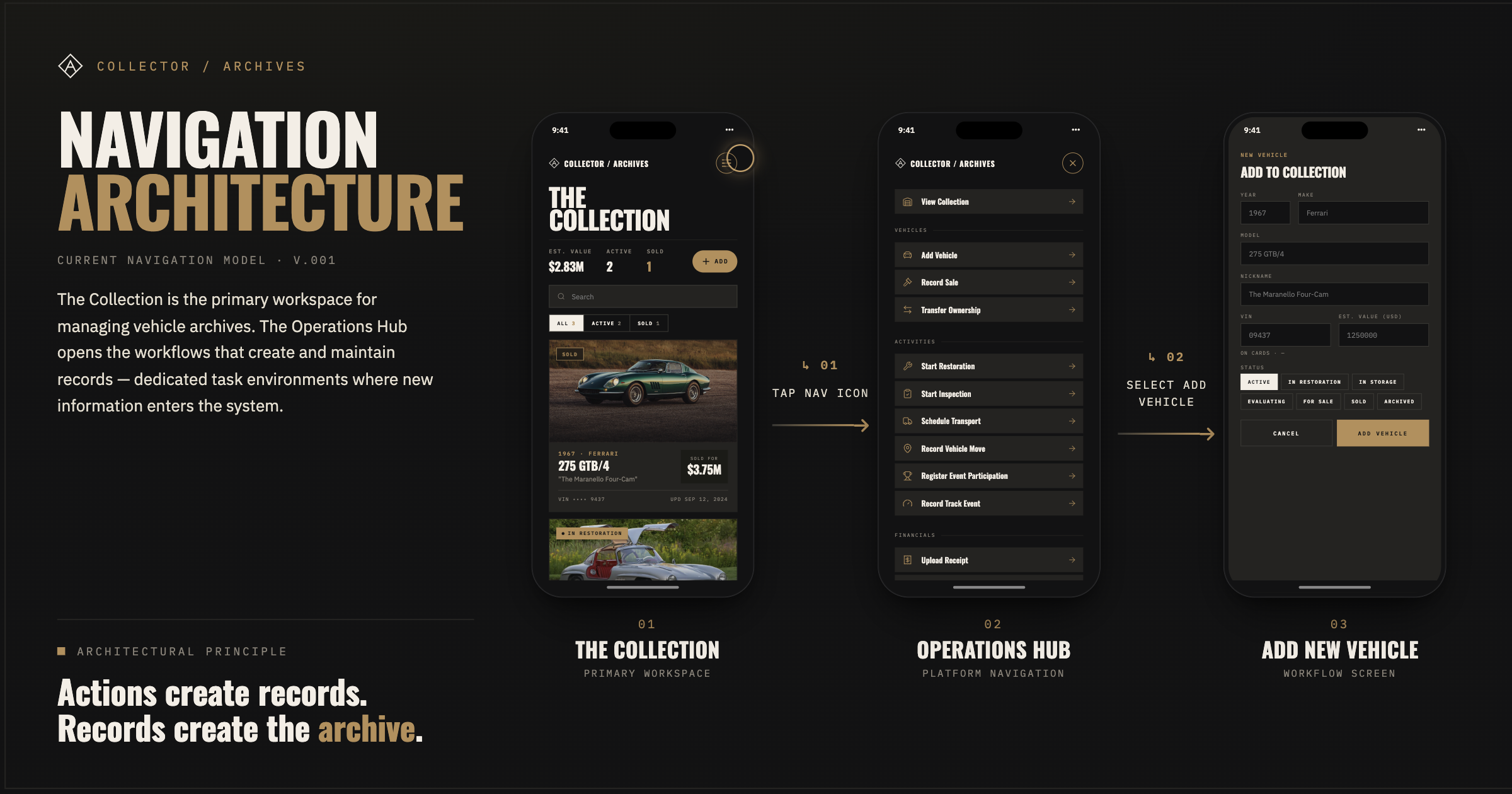
This update establishes the operational foundation of the archive: a new Operations Hub for managing activities across a collection, organized into Vehicles, Activities, Financials, and Documents.
Collector Archives continues to evolve.
This latest update focused on product architecture.
From the beginning, my goal for Collector Archives has been to document the complete lifecycle of a collector vehicle—from evaluation and acquisition to ownership, maintenance, restoration, transportation, events, sale, and long-term preservation.
This release focused on creating the operational foundation that supports those activities and the records they produce over time.
I introduced a new Operations Hub as the primary navigation layer for managing activities across a collection, while keeping the Collection as the main workspace for browsing and researching vehicles.
Current workflow categories now include:
- Vehicles — acquisition, ownership, transfer, and collection management.
- Activities — restorations, inspections, transportation, and vehicle movement.
- Financials — expense tracking, receipt management, reimbursement reporting, and future financial analysis.
- Documents — appraisals, reports, records, and other supporting materials that contribute to a vehicle’s historical record.
Together, these workflows create the operational foundation of the archive.
One principle continues to guide the design:
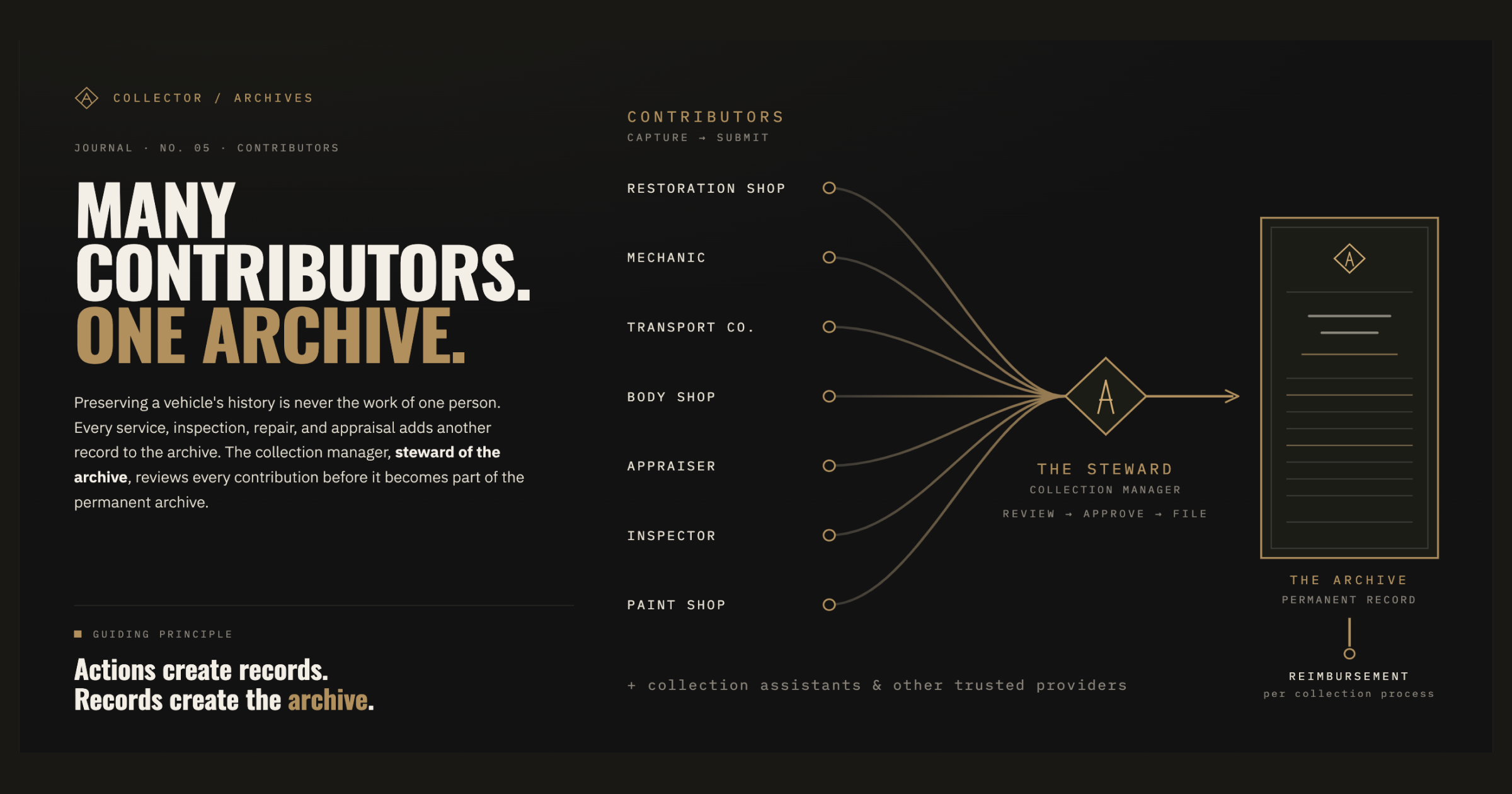
Actions create records. Records create the archive.
This update establishes a foundation for the next phase of the product: capturing, organizing, and preserving the information that collectors, collection managers, restorers, appraisers, and service providers create every day.
The next workflow I’m exploring is receipt and expense management.
The first pass is already in the prototype and focuses on AI-assisted receipt capture, extraction, and filing. I am refining the workflow to support restoration accounting, multi-vehicle invoices, and reimbursement reporting.
This workflow is available in the current prototype. To explore it, open the navigation menu in the upper-right corner, select Upload Receipt under Financials, and walk through the flow.
Keep in mind that this prototype is still under active development and many workflows are not yet functional. I’m documenting the process as the platform evolves, and will share a dedicated journal entry covering the receipt management workflow in more detail.
Collectors often spend years restoring vehicles and accumulate thousands of receipts, invoices, inspection reports, appraisals, shipping records, and supporting documents along the way.
I’m particularly interested in how AI can help automate that process through:
- OCR and computer vision
- Expense categorization
- Multi-vehicle invoice allocation
- Foreign currency conversion
- Restoration cost tracking
- Monthly reimbursement reporting
The goal isn’t simply to track expenses.
The goal is to preserve the financial history behind a vehicle’s story.
Release Highlights
- Introduced the Operations Hub as the primary navigation layer
- Established four workflow categories: Vehicles, Activities, Financials, and Documents
- Preserved Collection as the primary workspace for vehicle browsing and research
- Defined the operational architecture for creating and maintaining vehicle records
- Added the first iteration of AI-assisted receipt and expense management
- Established the foundation for restoration accounting and reimbursement workflows
- Formalized the guiding principle: Actions create records. Records create the archive.
More updates soon.
Written by
Julia Rudisill
Founder of Collector Archives. Documenting the product strategy, information architecture, and ownership workflows behind building a platform for collector vehicle owners.