Many Contributors. One Archive.
Since the last entry, Upload Receipt became Upload Expense — and grew into two connected prototypes. One for the collection manager who keeps the financial record, one for the contributors who do the work. This entry is about building both sides, and about the moment the project turns from designing workflows to validating them.
The previous entry was about a single document. This one is about the people on either side of it.
In Journal Entry 4, I introduced the workflow that turns a receipt into a permanent, structured record — line by line, allocated across the vehicles it actually belongs to. That entry was about what a record is. Since then, the work has been about who creates it, who reviews it, and how those two roles meet inside the same archive.
Quite a bit has changed. The workflow has a new name, a second prototype, and — for the first time — a date on the calendar to put it in front of real collectors.
From Upload Receipt to Upload Expense
A name that finally matches the intent
The first change is the smallest to describe and the most important to get right. Upload Receipt is now Upload Expense.
The original name described the gesture — point a camera at a piece of paper. But the gesture was never the point. Uploading the receipt is how the workflow begins; creating an accurate financial record is what it’s for. The receipt is preserved as evidence, permanently attached to the record it supports. But the record is the asset.
The goal was never to upload a receipt. It was to create a record — and keep the receipt as proof.
Renaming the feature realigned everything downstream: the menu entry, the confirmation language, the way the workflow talks about itself at every step. A contributor in the field and a collection manager at a desk are now doing the same named thing — recording an expense — even though they experience it very differently.
Two Prototypes, Two Roles
Collection manager and contributor
The biggest structural change since the last entry is that there are now two prototypes instead of one.
Until recently, every workflow lived inside the Collection Manager prototype. From the beginning, the vision for Collector Archives has been a set of connected experiences, each designed for a different role in a vehicle’s life. The Upload Expense workflow sits early on that roadmap, making it the first opportunity to bring a second experience to life with a dedicated Contributor prototype.
Splitting the work into two prototypes let each role be designed honestly, on its own terms, without diluting the other.
The Collection Manager Prototype
Submission through permanent archival
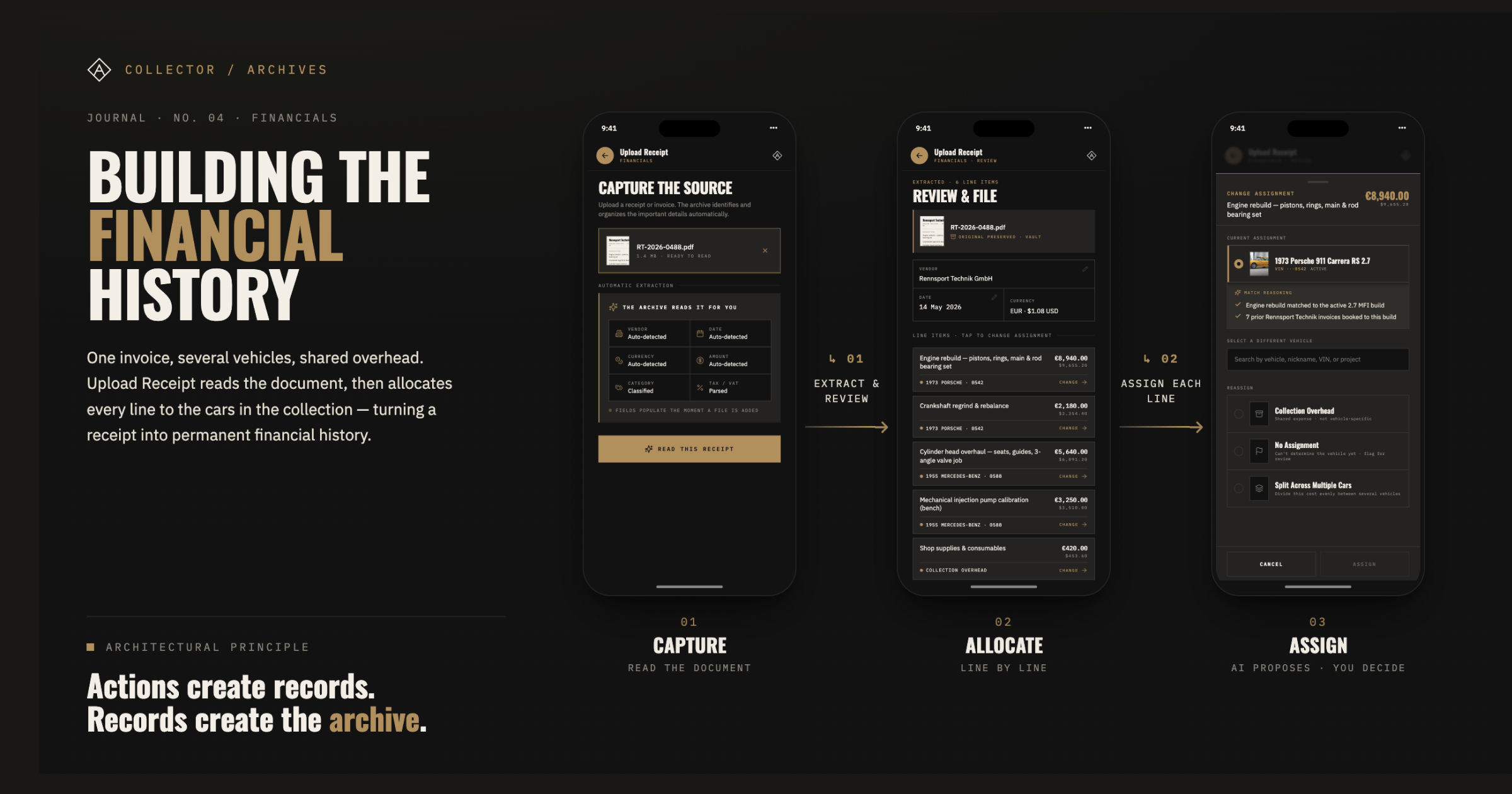
The collection-manager prototype is the full platform. It now carries the complete Upload Expense workflow described in the last entry — capture, read, review, allocate, file — along with everything required to process work that arrives from other people.
A manager can record an expense directly, and can also open a contributor’s submission, confirm or correct the extraction, finish the allocation, and file it to the permanent archive. The review experience is now complete from end to end: a submission enters, it is verified and allocated, and once it is filed it leaves the review queue and becomes part of the vehicle’s financial history.
The Contributor Prototype
Capture in the field, submit for review
The second prototype is dedicated to the Contributor.
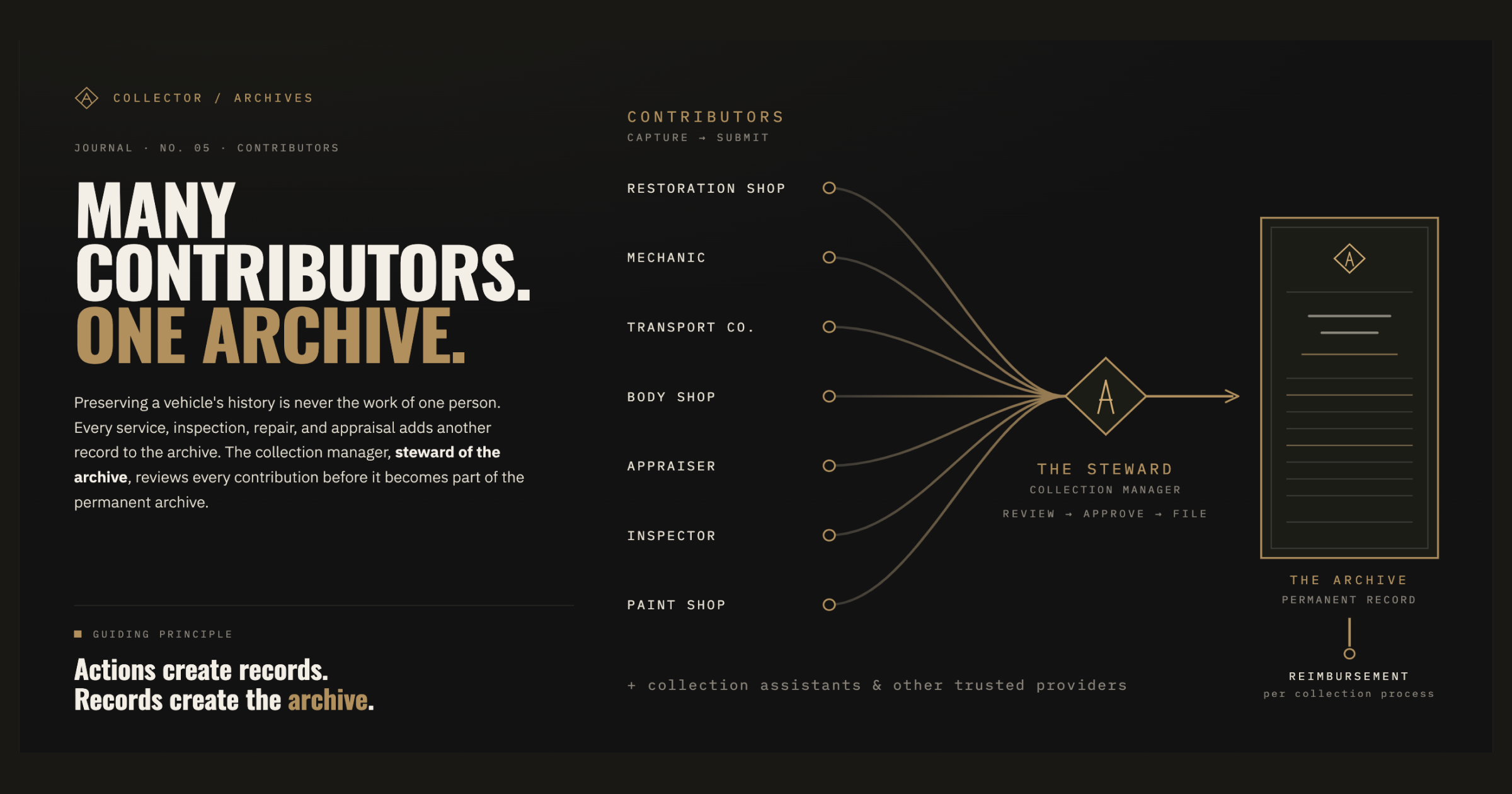
Today, the Contributor experience serves anyone who needs to submit information into the archive but isn’t responsible for managing the collection. That includes restoration shops, mechanics, transport companies, detailers, paint shops, appraisers, inspectors, collection assistants, and other trusted service providers.
Collector Archives is being designed as a platform of connected experiences, each built for a different role in a vehicle’s life. Many of these roles will eventually have dedicated experiences of their own. The Contributor prototype is the first step toward that broader vision, providing a shared workflow for capturing information and submitting it to the Collection Manager for review.
The Contributor experience is intentionally focused. It removes the complexity of managing a collection and centers on the task at hand—capturing information and submitting it for review.
The workflow begins by photographing a receipt. The archive extracts the relevant information automatically, allowing the contributor to confirm or adjust the details before submitting the expense.
Unlike the Collection Manager, a Contributor never commits records directly to the archive. Every submission is reviewed first, ensuring the Collection Manager remains the steward of the archive while allowing trusted contributors to participate in building a vehicle’s financial history.
Where the Two Sides Meet
One connected, end-to-end workflow
Two prototypes could easily have become two disconnected products. They didn’t, because they were built to meet at a single seam: the moment a contributor’s submission lands in the manager’s review queue.
The contributor hands off; the manager picks up. The same expense the contributor captured in a shop becomes the record the manager confirms, allocates, and files. When the manager finishes and files it to the archive, the submission disappears from the queue — reviewed, resolved, and permanent.
Separating the experiences made each one easier to design well. The contributor side could be made genuinely simple without worrying about the manager’s depth; the manager side could stay powerful without apologizing for its complexity. And because both were drawn from the same design system and the same record model, keeping them connected end-to-end took intention rather than heroics. Two prototypes, one archive.
Beginning User Validation
Conversations before code
With both workflows standing on their own, the project is entering a new phase. I’ve scheduled my first user-feedback sessions.
These conversations come before production code, on purpose. It would be easy to keep refining the prototype in private and convince myself it’s right. A workflow isn’t finished when the prototype works. It’s finished when it works for the people who use it. I’d rather discover what’s wrong in a conversation than in a codebase.
I’d rather the product evolve through conversations than through my own assumptions.
The prototypes exist precisely so these sessions can be concrete. Instead of describing an idea, I can hand someone a working flow, watch where they hesitate, and listen for the parts of their work I haven’t accounted for. Whatever I learn will shape what gets built first.
Looking Ahead
From records to reports
The next major area of exploration is reporting.
An individual expense record is useful. A collection of them, left as a list, is only mildly more so. The value compounds when those records can be summarized, filtered, grouped, analyzed, and shared — when a year of scattered invoices becomes a clear picture of what a restoration cost, what a vehicle costs to own, or exactly what is owed in a reimbursement.
That is the work the financial history has been quietly building toward. Every decision in the Upload Expense workflow — allocating by line item, preserving currency conversions, attributing expenses to vehicles and overhead — exists so that reporting can be accurate without anyone reassembling the data by hand. The next phase of design will explore how Collector Archives turns individual records into reports that collectors and collection managers can actually use.
One More Thing: Add Story
A teaser for a future entry
The ability to add a story has been part of the vision for Collector Archives from the beginning. While finishing the Upload Expense workflows, I started thinking more deeply about how that experience should work, so I roughed in the first concepts while the ideas were still fresh.
The workflow is still in its earliest stages and deserves a much deeper exploration before it’s ready.
The archive is very good at preserving a vehicle’s documented history: what was done, when, by whom, and for how much. But that isn’t the whole history.
There is also the life the vehicle has lived.
The memories. The road trips. The weekends. The races. The friendships formed around a shared passion. The stories passed from one generation to the next.
To someone walking past, it may simply look like a well-preserved vehicle.
But once you hear the stories, you never see it the same way again.
Those stories become part of the vehicle’s history just as surely as an inspection report, a restoration invoice, or a maintenance record. They deserve to be preserved alongside the records that document the vehicle’s life.
I’m still working through exactly how that experience should work, but I have a feeling it will become one of the most meaningful parts of Collector Archives.
Actions create records. Records create the archive.
Release Highlights
What’s new since the last entry
Upload Expense
-
Renamed Upload Receipt to Upload Expense — The workflow’s name now reflects its purpose — creating a financial record — while still preserving the original receipt as supporting evidence.
-
Expense-first language throughout — Menu entries, confirmations, and in-flow copy were realigned so the workflow describes itself consistently from capture through archival.
Collection Manager Prototype
-
Complete Upload Expense workflow — Capture, read, review, allocate, and file are in place end to end, including per-line allocation across vehicles and collection overhead.
-
Contributor submission review — Managers can open a contributor’s submission, confirm or correct the extraction, complete the allocation, and file it to the archive.
-
Review queue clears on filing — Once a submission is reviewed and filed, it is removed from the Awaiting Review queue, leaving an accurate picture of outstanding work.
-
Operations hub with clear status — Workflows still in design are marked plainly, so it’s obvious which paths are available to explore and which are coming next.
Contributor Prototype
-
A dedicated contributor experience — A second prototype built for the people who do the work — deliberately narrow, with the collection as the landing page and a single menu of permitted actions.
-
Contributor Upload Expense — The same capture-and-confirm flow, scaled down to what a contributor needs to record an expense from the field.
-
Submit for review — Contributors never file to the archive. Each expense is submitted to the collection manager, who reviews and files it.
-
Notes captured in context — There is no standalone note. A note belongs to the record being created, so it travels with the expense rather than existing on its own.
-
One model for every profession — Shops, transporters, inspectors, photographers, and others share a single contributor experience rather than separate, bespoke interfaces.
Both prototypes are part of the current Collector Archives build. In the Collection Manager prototype, open the main menu (☰), go to Financials, and select Upload Expense — or open Complete Tasks to review a contributor’s submission from start to finish. In the Contributor prototype, the collection is the landing page; open the menu and choose Upload Expense to capture and submit from the field.
More updates soon.
Written by
Julia Rudisill
Founder of Collector Archives. Documenting the product strategy, information architecture, and ownership workflows behind building a platform for collector vehicle owners.